
Published: 18 June 2026 | Category: Feature
1. Broadband in Subdivided Flats: Is It Actually Legal?
Many friends renting subdivided flats immediately wonder: "My room is just a small partitioned space in a larger unit. Is it actually legal to install broadband? Will telecom providers even bother pulling wires for me?" In Hong Kong, there's no rule saying "installing broadband in a subdivided flat is illegal." The general rule for telecom providers (like HKT, HKBN, etc.) is simple: as long as there's a clear address, conduits for wiring, and the landlord's consent, they're more than happy to do business with you. However, in reality, you'll often run into plenty of grey areas and pushback.
First off, the biggest headache is "address registration." In the telecom providers' systems, they usually only have the main address like "Flat A, X Floor," not "Room A1, A2, A3." If you register using the main address and another tenant has already installed broadband, the system might show "line full" or require extra wiring. To successfully apply for broadband in a subdivided flat, you need to pay attention to these key legal and administrative details:
- Landlord's nod: Installing fiber usually requires drilling holes in the corridor or walls. If the technician drills without the landlord's consent, you could easily lose your deposit when moving out, which just isn't worth it.
- Fire safety regulations: Corridors in subdivided flats are usually quite narrow. If the broadband cables are too messy or block the fire escape route, it might violate the Deed of Mutual Covenant or fire safety regulations, giving the management office the right to cut the wires.
- Independent door plates: It's best to confirm with your landlord if the mailboxes or door plates are clearly separated. This helps the technician find your unit and ensures your future bills don't get sent to the wrong person.
- Building access rights: Some older tong laus or single-block buildings might only have fiber networks laid by one or two telecom providers. This means you're forced to choose them with no room to compare prices.
In short, installing broadband in a subdivided flat is legally permissible, but to get it done smoothly, upfront communication with your landlord is an absolute must. Whatever you do, don't secretly call a technician up to pull wires on your own, or you'll be dealing with a massive headache later.
2. Extremely Difficult Wiring? Four Common Technical Hurdles
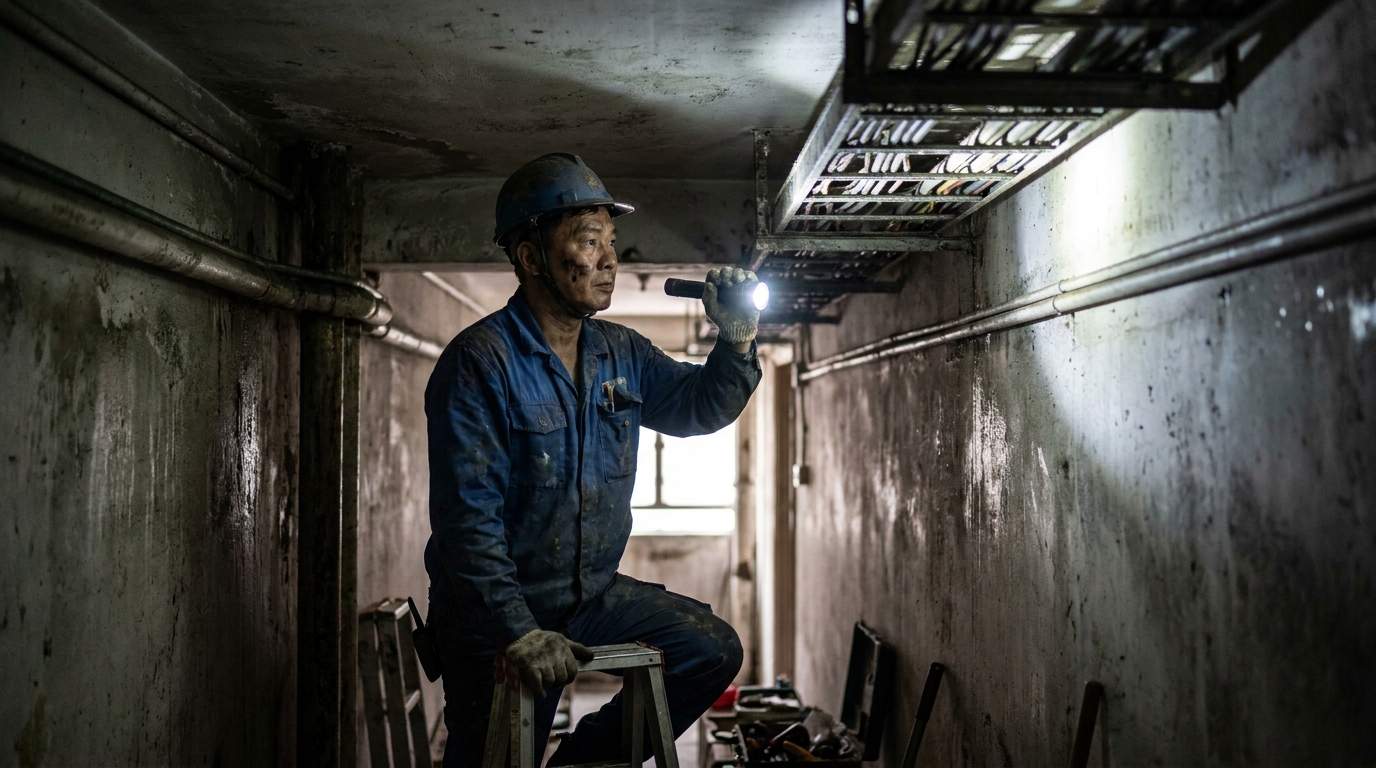
Even if the landlord says OK and you clear the legal hurdles, it doesn't mean the broadband technician will definitely be able to install it. Many subdivided flat tenants have experienced this: you've paid and signed the contract at a street booth or online, but when the technician arrives and takes one look, they shake their head and say "can't be done," forcing you to cancel the order. Wiring in subdivided flats is notoriously difficult mainly because the original building structure has been heavily altered, making traditional Fiber-To-The-Home (FTTH) a massive challenge.
To help you mentally prepare, we've compiled the four most common technical hurdles when installing traditional fiber broadband in subdivided flats:
- Concealed conduits are blocked or non-existent: When converting a large unit into subdivided flats, contractors often only focus on water and electricity, completely forgetting to leave concealed conduits for telecom cables. Even if they exist, they might be so stuffed with other wires that a fiber cable can't pass through.
- Sealed false ceilings: Many subdivided flat corridors have false ceilings to hide pipes. If the false ceiling is completely sealed (no access panels), the broadband technician simply can't pull the wire from the main entrance into your room.
- Blocked by structural walls: For soundproofing or partitioning, subdivided flats might have added brick walls. If there are several walls in between and you aren't allowed to drill holes for surface wiring, the fiber can't enter the room. Even if you place the router near the main entrance, the Wi-Fi signal inside your room will be severely weakened.
- Insufficient ports in the main unit: A large unit might only have one or two fiber ports. If the tenants in rooms A1 and A2 are already using them, even if you in room A3 want to install broadband, the telecom provider would have to pull a new main line all the way from the switch room. It's a huge project and often gets rejected.
⚠️ Note: Never casually ask an outside electrician to splice your fiber cables! The inside of a fiber cable is made of glass fiber. Once it's bent or snapped, it's completely ruined and must be spliced by a telecom provider's professional technician using specialized equipment.
3. Fiber Broadband vs 5G Home Broadband: Which is Best for Subdivided Flats?
Since traditional fiber broadband is fraught with difficulties, the currently trending "5G home broadband" is an absolute lifesaver for subdivided flat tenants! In recent years, major telecom providers (like CMHK, SmarTone, 3HK, and CSL) have been heavily promoting 5G broadband, boasting a "no wiring, plug-and-play" experience. This technology essentially gives you a router with a built-in 5G SIM card, converting the received 5G mobile signal into your home's Wi-Fi, perfectly bypassing all renovation and wiring hassles.
So, which is the better deal: fiber broadband or 5G home broadband? Let's break it down right now with a comparison table:
| Comparison Item | Traditional Fiber Broadband (1000M) | 5G Home Broadband |
|---|---|---|
| Installation Method | Requires booking a technician for wiring and drilling | Pick up the device at a store, plug and play at home |
| Speed & Stability | Extremely high and stable, low Ping for gaming | Depends on local 5G coverage; rain might cause slight interference |
| Average Monthly Fee | Around $128 - $198 | Around $118 - $168 |
| Relocation Flexibility | Requires a relocation fee of a few hundred dollars; new address might lack coverage | Extremely high! Just take the device to your new home, plug it in, and keep using it |
| Fair Usage Policy (FUP) | Truly unlimited, no speed throttling | Some plans throttle speed after hitting 200GB/300GB |
As you can see from the table above, 5G broadband is absolutely the top choice for subdivided flat tenants who move frequently or are on a one-year fixed lease. You don't need to worry about the landlord's approval, nor do you have to fear damaging the walls. As long as your room is near a window or there's a cell tower nearby, streaming Netflix in 4K or even light gaming will be a breeze. However, if you're a hardcore gamer with extremely high demands for low latency (Ping), then you'll have to figure out a way to pull fiber, no matter how hard it is.

4. Must-Read Tips & Trap-Avoidance Guide for Picking a Plan
Once you've decided between fiber and 5G broadband, picking a plan and signing the contract is an art in itself. Many subdivided flat tenants go for the cheapest option without reading the contract terms, only to deeply regret it when they need to move or when the network slows to a crawl. As a smart consumer, you must watch out for these traps before signing any broadband contract:
- Match the contract period with your lease: Subdivided flat leases are usually "one year fixed, one year flexible," but many broadband plans easily lock you in for 24 or even 36 months. If you move after a year and the new address can't be installed (e.g., no fiber coverage), you'll have to eat the remaining monthly fees. It's highly recommended to find short-term contracts (like 12 months) or plans with waived relocation fees.
- Beware of hefty relocation fees: If you use traditional fiber, paying a relocation fee when moving is common sense, usually ranging from $400 to $680. Some telecom providers will waive the relocation fee once, so remember to ask the sales rep clearly before signing.
- Read the 5G FUP terms clearly: If you choose 5G broadband, you must read the "Fair Usage Policy" (FUP) carefully. Some cheap plans at $118/mo only give you 200GB of full-speed data, after which you'll be throttled to 5Mbps—making even 1080p YouTube videos stutter. If a family of several people is using it, it's best to pick a "truly unlimited" plan or one with at least 500GB.
- Renting vs buying the router: 5G broadband usually requires a 5G router. Some plans include the rental in the monthly fee (you return it when the contract ends), while others require you to buy the device outright (around $1,500 - $2,500). Do the math to see which is more cost-effective.
💡 Tip: If you plan to use 5G home broadband, we strongly recommend buying a prepaid SIM card from that telecom provider (like SmarTone or CMHK) first to do a real-world speed test inside your subdivided flat. Test it once by the window and once by your bed to see if the download speed and Ping are acceptable. Make sure there are no dead zones before signing a long-term contract!

5. Summary: Find the Right Method for Fast Internet in Subdivided Flats
Living in a subdivided flat means limited space, but it absolutely doesn't mean you have to sacrifice your internet quality. Figuring out the legality and communicating well with your landlord is the first step to installing broadband. If you run into technical wiring difficulties, don't lose hope, because technological advancements have already provided excellent alternatives. Let's summarize the key takeaways:
- Traditional fiber broadband primarily requires the landlord's consent and clear conduits. Forcing a wire installation could lead to legal or compensation risks.
- 5G home broadband is currently the most cost-effective and flexible choice for subdivided flat tenants. It's plug-and-play with no wiring needed, and moving is hassle-free.
- Before signing a contract, always double-check the contract period, relocation fee terms, and 5G data FUP limits. Never sign blindly just because the monthly fee looks cheap.
🔥 KingBroadband Recommended Services
Don't want to call every telecom provider yourself? Think the contract terms of different companies are too complicated? Reach out to us at kingbroadband.com right now! Our professional team will instantly assess the fiber coverage based on your subdivided flat address and provide the latest, most cost-effective 5G home broadband quotes. We help you save time and money so you can enjoy high-speed internet immediately!
Pick the right broadband, and you can comfortably binge-watch shows and game when you get home. We hope this guide helps all our friends living in subdivided flats. Wishing you smooth surfing and lag-free gaming!