
Published: 26 May 2026 | Category: Area Guide
1. Why is public housing broadband so cheap?
If you live in a public housing estate in Hong Kong, congratulations! You're already ahead of the game because public housing broadband plans are usually the cheapest in the city. While many private housing or village house residents have to pay over $200 or even $300 a month for 1000M fiber, public housing tenants can often get it sorted for around a hundred bucks. Why the massive difference? It all comes down to cost and competition.
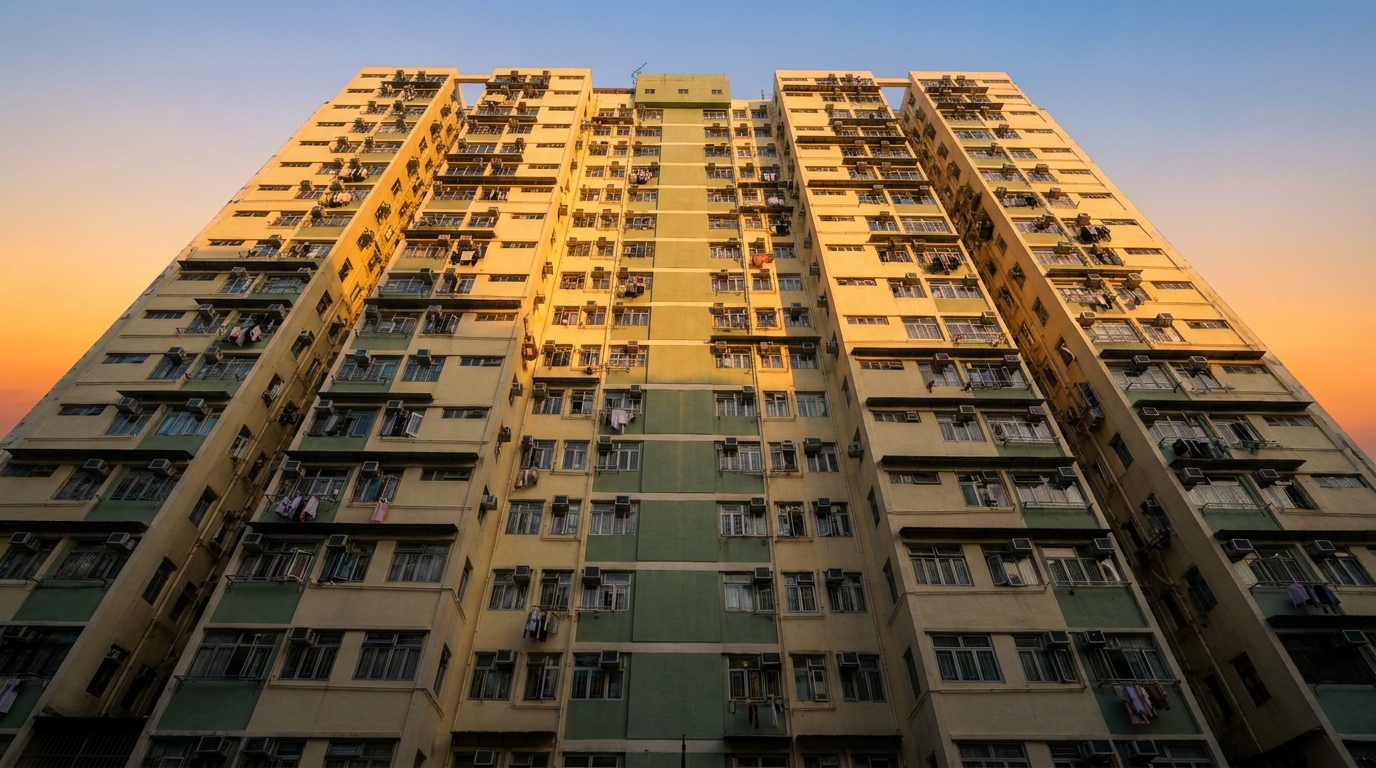
Public housing estates are extremely densely populated, with hundreds or even over a thousand units in a single block. For major telecom providers (like HKT, HKBN, and CMHK), the average cost of laying a fiber network in public housing is incredibly low. Once they pull a main fiber trunk into the building's switch room, it's easy to distribute it to all the tenants. Plus, with such a massive customer base, providers often trigger fierce price wars to grab market share—which is why you always see those broadband street booths aggressively pitching deals downstairs.
- High population density: Network rollout costs are heavily diluted, leaving high profit margins and plenty of room for price cuts.
- Super easy installation: Switch rooms and conduits in public housing are standardized. Technicians can usually finish pulling the cables in 30 to 60 minutes, saving on labor costs.
- Fierce price wars: Almost every estate is covered by 3 to 4 mainstream providers. To fight for market share, public housing plans always offer the most aggressive discounts.
- No monopolies: Unlike some single-block private buildings or tong laus monopolized by a single provider, public housing tenants have plenty of choices and natural bargaining power.
2. FTTH or VDSL? Check your estate's coverage
Even though public housing broadband is cheap, it doesn't guarantee every unit gets ultra-fast internet. Before signing a contract, the most crucial step is to figure out whether your specific estate and block support "Fiber To The Home" (FTTH) or if they're still stuck with old-school "copper telephone lines" (VDSL). The difference in speed and stability between the two is night and day.
Newly built public housing (like Queen's Hill Estate and Hoi Tat Estate) basically have 100% FTTH coverage from major providers, offering 1000M or even 2500M speeds. But if you live in an older estate with decades of history (like Wah Fu Estate, Choi Hung Estate, or the older wings of So Uk Estate), you need to check if the building's switch room has enough "fiber ports". Sometimes the building has fiber, but because too many people applied, the ports are full (commonly known as "no port"). The technician won't be able to pull a fiber line for you, and you'll be forced to settle for 100M VDSL broadband.
| Network Tech | Common Speeds | Stability & Latency | Best For |
|---|---|---|---|
| FTTH (Fiber To The Home) | 1000M / 2000M / 2500M | Extremely high, ultra-low ping, unaffected by weather | Gaming, 4K streaming, multiple users at home |
| VDSL (Copper/Telephone Line) | 30M / 100M | Average, prone to interference, very slow upload speeds | Basic browsing, web surfing, elderly users with minimal speed needs |
⚠️ Warning: Never sign a contract blindly without checking coverage! Some older estates might only have one or two providers that successfully laid fiber. We strongly recommend using broadband quotation sites or asking a sales rep to check your exact unit address to confirm fiber availability, rather than just relying on the estate name.
3. Major providers' public housing broadband plans compared
Right now, the monthly fee for 1000M public housing fiber broadband ranges from $78 to $138, depending on the provider, contract length, and whether it includes a router or other welcome gifts. Mainstream providers all have their own strengths—some compete on price, while others focus on stability. You can choose based on your budget and needs.
Generally speaking, CMHK and HKBN have the most fiercely competitive public housing plans, often dropping surprise prices below $100. While HKT (Netvigator) is priced slightly higher, it boasts the largest overseas bandwidth in Hong Kong and excellent stability. For users who frequently game on overseas servers or need a stable connection for WFH meetings, it remains the top choice. HGC also occasionally rolls out fee-waiver promotions for a few months to grab customers.
| Provider (Est.) | Est. 1000M Monthly Fee | Contract Length | Key Selling Points / Features |
|---|---|---|---|
| CMHK | Around $78 - $99 | 24-36 months | Extremely high CP value, usually the cheapest, great for budget-conscious users |
| HKBN | Around $89 - $109 | 24-36 months | Good connection quality, often bundles streaming platforms or antivirus software |
| HKT | Around $109 - $138 | 24-36 months | Smoothest for gaming, most stable overseas routing, offers dedicated Gamer line upgrades |
| HGC | Around $89 - $119 | 24-36 months | Frequent monthly fee waivers, making the effective monthly cost very attractive |
*Note: The prices above are for reference only. Actual fees will vary depending on the estate, welcome offers, and application time. Always refer to the latest quotes.

4. Must-read before signing! Hidden details and money-saving tips
Don't rush to sign the dotted line just because you see a cheap plan. Broadband contracts are full of hidden details. If you aren't careful, you could end up losing more than you save. Public housing residents should definitely keep these money-saving tips and hidden traps in mind:
- Installation fee waivers: Most new public housing contracts will waive the $680 installation fee. However, for very short contracts or special cases, you might still be charged. Always ask clearly if the installation is "completely free" before signing.
- Bundle a router or buy your own? Providers often try to upsell you by adding $20-$30 a month to rent their Wi-Fi router. Over a two-year contract, that adds up to hundreds or even a thousand bucks, and you might only get an older Wi-Fi 5 model. It's much better to hit up a computer center and buy your own Wi-Fi 6 router for a few hundred dollars. It's faster, you own it, and the CP value is way higher.
- Relocation fees and estate transfers: If you expect to transfer to a new public housing unit or buy a HOS flat in the next year or two, pay attention to the "relocation fee" in the contract. Some companies charge anywhere from $300 to $600, while others throw in one free relocation.
- Auto-renewal traps: Remember your contract expiry date! Often, if you don't proactively cancel or renew when the contract ends, the monthly fee will automatically jump back to the expensive "standard price". We recommend shopping around 2-3 months before it expires.
💡 Tip: The price quoted by the street booth sales guy isn't necessarily the cheapest in town! Online quotation platforms can often aggregate hidden offers from multiple companies and even throw in exclusive supermarket vouchers. Comparing options and doing your homework is the smart move.
5. Can't get fiber? Is 5G home broadband a good alternative?
As mentioned earlier, some older public housing estates might not have fiber ports in the switch room, making it impossible to install 1000M broadband. If you run into this, rather than settling for slow and unstable 100M VDSL, consider the highly popular "5G home broadband". Major mobile providers (like SmarTone, 3HK, CMHK, and CSL) all offer these services.
The biggest advantage of 5G home broadband is that it's "Plug & Play". You don't need a technician to come and pull cables, saving you the hassle of waiting for installation. As long as you get a good 5G signal near your window, speeds can easily hit 300M to 500M or more, which is more than enough for 4K Netflix or casual gaming. Public housing 5G broadband plans cost around $88 to $148 a month, and they usually include a 5G router on loan.
🔥 5G Broadband Pros & Cons at a Glance
- Pros: Zero installation fee, no cable pulling, plug & play, can be moved anywhere anytime (just update the address), and no worries about full switch room ports.
- Cons: Stability and ping will never beat a physical fiber line. If your flat is in a 5G blind spot (like facing an enclosed light well), speeds will drop significantly.

6. Summary: Find the best deal and don't get ripped off
Applying for broadband in public housing is definitely a perk, as you have access to the cheapest internet options in Hong Kong. However, to truly maximize your savings, you need to be a smart consumer. Let's summarize the golden rules for public housing broadband:
- Check coverage first: Confirm your unit can get 1000M FTTH and avoid old 100M tech.
- Shop around: Don't impulsively sign with the first cheap street booth you see. Compare monthly fees and welcome offers (like supermarket vouchers) from at least two or three providers.
- Read the terms: Ask clearly about installation fees, relocation fees, and whether the router is free or requires a monthly rental fee.
- Consider backups: If there really are no fiber ports left, decisively switch to 5G home broadband. The speeds are vastly superior to old telephone lines.
As long as you're prepared, every public housing tenant can easily enjoy ultra-fast, seamless internet at rock-bottom prices. Give your current home broadband contract a quick check-up right now and see if you can switch providers to save some cash!