
Published: 24 September 2026 | Category: Travel Data
1. Dual-Destination Trips Are Trending: Why Do You Need a Combo SIM?
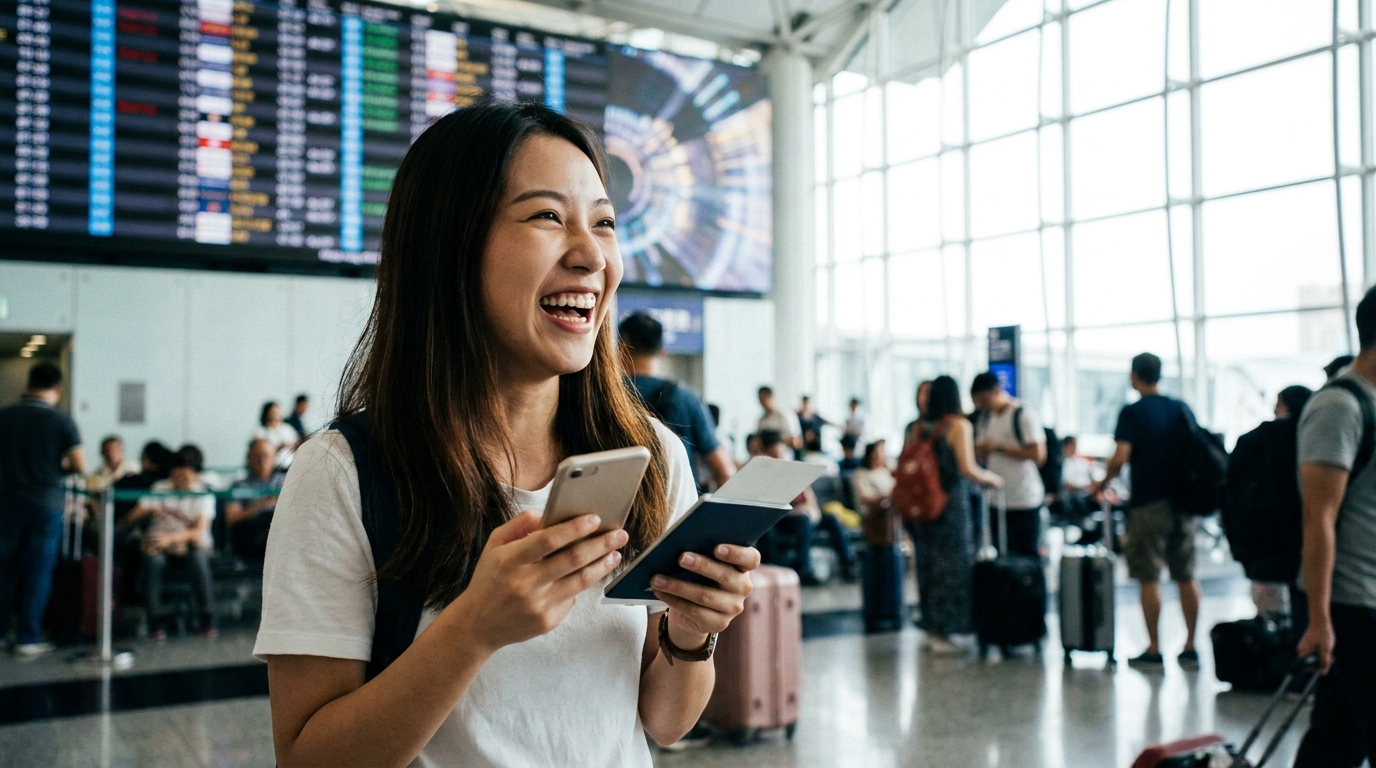
With more flight options than ever, many Hongkongers love doing "dual-destination trips"—like flying to Tokyo for a few days of shopping, then hopping on a plane straight to Seoul for K-BBQ and a skincare haul before heading back to HK. For this kind of "best of both worlds" itinerary, buying separate single-country SIM cards is just a massive hassle. Fast forward to 2026, Japan-Korea Combo SIMs or Asia-wide eSIMs have become the go-to choice for travel gurus and business travellers alike. When you're travelling, every second counts, and a single SIM card that covers multiple countries is definitely the way to go.
Why do we highly recommend switching to a Combo SIM that covers both destinations? Aside from saving money, there are plenty of practical benefits. Here are a few key advantages you need to know:
- Seamless connectivity: The moment you land at Seoul Incheon from Tokyo Narita, you don't have to frantically search for a SIM ejector pin in the cabin. Just restart your phone when you land, and you'll instantly connect to the Korean network to text your family or call an Uber.
- No more lost HK SIMs: The biggest fear when swapping physical cards is losing your primary HK SIM. Using a Combo SIM or an eSIM drastically reduces the risk of dropping your card, so you won't be left without SMS access when you return to Hong Kong.
- Easier data management: One card covers your data for both places. You don't need to remember how much data is left on your Japan card versus your Korea card—your data quota for the entire trip is clear at a glance.
- Better value for money: Buying an 8-day or 10-day dual-country card usually gives you a cheaper daily average rate than buying two separate 5-day cards. For budget-conscious HK consumers, it's an absolute steal.
2. Three Golden Rules for Choosing a Japan-Korea Combo SIM in 2026
Picking a Japan-Korea Combo SIM isn't just about grabbing the cheapest one you can find. In 2026, 5G networks are everywhere. If you're still buying old, discounted cards capped at 3G/4G speeds, you might not even be able to load Google Maps in crowded hotspots like Shinjuku or Myeongdong—which is incredibly frustrating. Whether you're buying a physical SIM or an eSIM, read the fine print before paying. Some cards advertise "unlimited data," but the devil is in the details, often hiding sneaky FUP (Fair Usage Policy) traps.
To make sure you can smoothly post on IG, stream videos, and reply to emails in both Tokyo and Seoul, we've summed up the three core criteria for choosing a Japan-Korea travel data card this year:
- Check the local partner networks: For Japan, it's best to pick a card that uses the Docomo or SoftBank network; for Korea, SKT or KT should be your top picks. These are the local telecom giants with the best coverage and stability, so you won't lose connection even in the suburbs or at ski resorts.
- Daily high-speed data allowance (FUP): Don't blindly chase "unlimited" plans. Always check exactly how many GBs of true full-speed 5G/4G you get per day. We recommend basic users get at least 1GB to 2GB of full-speed data daily before it throttles down to 384kbps or 128kbps. If you're a heavy user (scrolling IG Reels, joining video calls), go for a plan with 3GB or more per day.
- Tethering support: If you're bringing a laptop on your trip or want to share Wi-Fi with older relatives travelling with you, make sure the card doesn't block the hotspot feature. Some budget cards strictly prohibit data sharing.
💡 Tip: If you're using an iPhone 14 or a newer model, we highly recommend going straight for an eSIM plan. Not only is it eco-friendly, but you can also scan the QR code and set it up in Hong Kong before you fly. Once you land, just toggle it on—it's super convenient!
3. Comparing Popular Japan-Korea Roaming Plans on the Market
Right now, major Hong Kong telecoms like HKT, HKBN, CMHK, SmarTone, and 3HK all offer daily roaming plans or travel SIM cards targeting the Asia-Pacific region. On top of that, online shopping platforms and Sham Shui Po's Apliu Street are flooded with third-party Combo SIMs. So which option is best for you? We can break them down into three main categories: direct telecom roaming, third-party physical Combo SIMs, and emerging travel eSIM platforms.
The biggest perk of direct telecom roaming is that it requires zero setup—just buy it via their app and you're good to go. Plus, if anything goes wrong abroad, you can call HK customer service directly. However, it's relatively pricey. If you want to save money, buying a third-party card or an eSIM is much better value. We've put together a comparison table below so you can see the differences at a glance:
| Plan Type | Average Daily Cost | Pros | Best For |
|---|---|---|---|
| Local Telecom Daily Roaming (e.g., HKT, CMHK, SmarTone) | Approx. $25 - $40 / day | Plug and play, no SIM swapping, can receive calls on original number, highest network priority | Business travellers, those wanting ultimate convenience, users with a flexible budget |
| Travel eSIM Platforms (APAC Multi-Country Plans) | Approx. $15 - $25 / day | No physical card needed, flexible day combinations, buy and use instantly | Younger users with newer phones, last-minute buyers |
| Third-Party Physical Combo SIMs (Sham Shui Po / Online) | Approx. $10 - $20 / day | Cheapest option, plug and play, great for older phones without eSIM support | Elderly travellers, budget-conscious users, those with non-eSIM phones |
4. Pro Tips: How to Avoid Connectivity Nightmares in Tokyo and Seoul
Buying a great SIM card is useless if it doesn't work when you get there! Many Hongkongers fly to Japan or Korea, panic the moment they land without internet, and assume the card is broken. In reality, 90% of the time, it's just incorrect phone settings. Because Japan-Korea Combo SIMs rely on cross-border roaming agreements, the setup is slightly different from single-country cards—especially when it comes to APN (Access Point Name) settings and the data roaming toggle.
To make sure you can smoothly exit the airport and find your ride, we've prepared the following troubleshooting checklist to help you avoid any pitfalls. If you still can't connect to the internet five minutes after landing, following these steps will usually fix the issue:
- Turn on "Data Roaming": This is the step most people miss! Because a Combo SIM is essentially a foreign card (it might be issued in HK, or it could be an Asia-wide card issued in Thailand), it operates in a roaming state when you're in Japan or Korea. You absolutely must toggle on "Data Roaming" in your phone settings to get a signal.
- Check your APN settings: Most phones will auto-detect this, but sometimes it fails. Pull out the instruction manual that came with the packaging and double-check if the APN in your phone is typed correctly (e.g., some cards require the APN to be set to "internet" or "emobile").
- Manually select the network provider: If your phone is stuck on 3G or only has one bar of signal, go into your settings, turn off "Automatic Network Selection," and manually pick a network. Try SoftBank or Docomo in Japan, and SKT in Korea. Usually, picking the right network will instantly bump you back up to 5G.
- The classic restart: Whenever you fly from Japan to Korea, or vice versa, it's best to turn your phone off and on again after changing countries. This forces it to search for the strongest local cell towers.
⚠️ Warning: If you use a custom Profile for internet access back in Hong Kong, it's best to delete it before you fly. Often, old profiles will block the APN of your new travel card, making it impossible to connect no matter how you set it up.
5. Summary: One Card for Seamless Travel Across Japan and Korea
To sum up, whether you're travelling to Japan and Korea for leisure or business, buying a high-quality Japan-Korea Combo SIM or eSIM in advance will definitely save you a lot of time and hassle. Travel in 2026 is all about speed and convenience—there's no point in stressing over your whole trip just to save a few bucks. Whether you ultimately choose a daily roaming plan from major telecoms (like CSL, 3HK, etc.) or buy a high-capacity dual-country card online, the most important thing is to clearly understand your data needs and your phone's compatibility.
Before you take off, use this final checklist to make sure everything is foolproof:
- Confirm if your phone is unlocked (not tied to a specific carrier) and whether it supports eSIM functionality.
- Estimate your daily data usage and buy a plan with enough GBs to avoid getting throttled mid-trip.
- Screenshot and save the eSIM QR code or the physical card's APN setup instructions on your phone, or even print them out as a backup.
- If you're travelling with family, confirm that the card you bought supports hotspot data sharing.
🔥 Next Steps
If you feel like comparing all these options is taking up too much time and you just want the best, most stable travel data or local home broadband plan, keep an eye on our website for the latest quotes and promotions. Let us do the heavy lifting and find the perfect plan for you! Wishing you an amazing Japan and Korea trip with seamless connectivity!