
Published: 17 May 2026 | Category: Enterprise
1. Why Do You Need Dedicated Fiber for HKEX Trading?
When it comes to financial trading in Hong Kong, especially for brokerages, hedge funds, or institutions focused on High-Frequency Trading (HFT), network requirements are on a whole different level compared to your average SME. If you're just watching videos or sending emails in the office, standard commercial broadband is more than enough. But if you're connecting to the Hong Kong Exchanges and Clearing (HKEX) to execute trades, a single microsecond of lag can easily cost you hundreds of thousands, or even millions, of dollars.
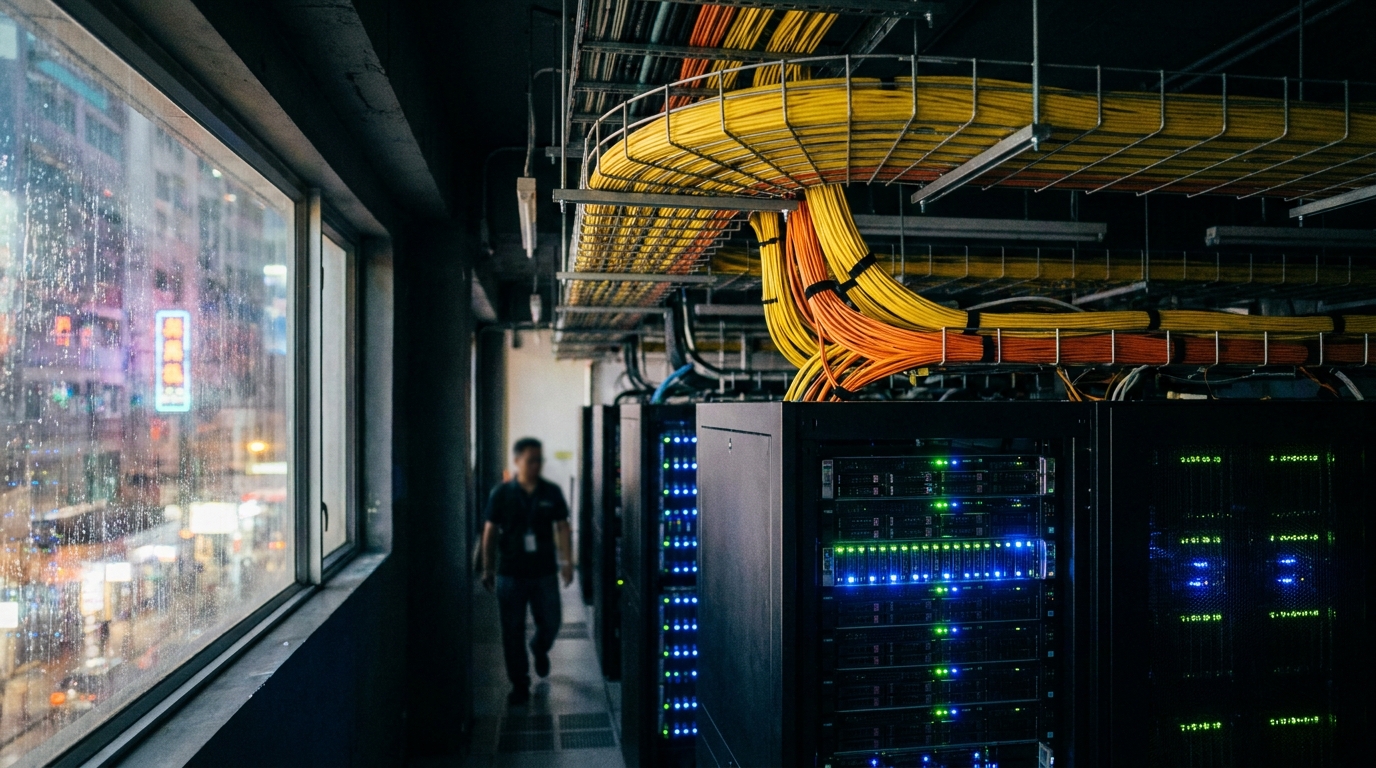
So why must you choose "dedicated fiber" over regular broadband? Because a Dedicated Line (or Leased Line) is an exclusive point-to-point connection where you don't have to share bandwidth with anyone else. Even if there's massive network congestion outside, your line stays completely clear. For clients needing a direct connection to HKEX data centers (like the TKO Data Centre in Tseung Kwan O), the physical distance and routing design of this line are built entirely for speed and precision.
- Dedicated Bandwidth: Guarantees 100% bandwidth availability, unaffected by peak hours, keeping you in top form at all times.
- Point-to-Point Direct Connection: Runs straight from your company's server room to HKEX without passing through unnecessary public routers, minimizing transit time.
- Ultra-High Security: Because it's a completely independent intranet architecture, it's incredibly difficult for hackers to intercept your sensitive trading data mid-transit.
2. The Battle for Speed: Bandwidth or Latency?
Many people think broadband speed is everything, immediately asking, "Do you have 10Gbps or 100Gbps plans?" But for an HKEX dedicated line, latency is often far more critical than raw bandwidth. Data packets for trading commands are usually tiny, so a 100Mbps dedicated line is actually more than enough to transmit a massive volume of orders at lightning speed. However, the Round-Trip Time (RTT)—from the moment you click the button to when the exchange server receives the command and confirms it back to you—is the true deciding factor.
For a true Low Latency Route, telecom providers will specifically lay a fiber optic cable with the shortest possible physical distance. For example, from a Central office straight to Tseung Kwan O, they'll bypass roundabout infrastructure and cut directly across Victoria Harbour, aiming to push latency down to 1 microsecond or even lower. Let's compare standard commercial broadband with a dedicated line below:
| Feature | Standard Enterprise Broadband (DIA) | HKEX Ultra-Low Latency Dedicated Line |
|---|---|---|
| Routing Design | Dynamic routing, passes through multiple street exchanges | Point-to-point straight line, shortest physical distance |
| Expected Latency | A few milliseconds (ms) to over a dozen ms | Guaranteed within microseconds |
| Monthly Fee Reference | Approx. $1,000 - $3,000 | $10,000+ (depends on bandwidth & distance) |
💡 Tip: If you're a small to medium-sized brokerage, you might not need a top-tier microsecond dedicated line. You can consider applying for a standard Point-to-Point Ethernet line. The monthly fee is significantly cheaper, but the stability and speed are still vastly superior to regular commercial broadband.
3. Stability is Everything: How Important are SLA and Redundancy?
Besides speed, stability is the absolute lifeblood of financial trading. Just imagine if your connection drops 5 minutes before the market opens or closes—the financial loss could easily cover years of dedicated line monthly fees! That's why when choosing an HKEX fiber dedicated line, you must carefully check the SLA (Service Level Agreement) provided by the telecom operator and ensure there's adequate Redundancy.
Top-tier enterprise dedicated line SLAs usually guarantee 99.95% or even 99.99% Uptime. If they fail to meet this standard, the telecom provider is required to compensate you proportionally. To achieve such high stability, relying on a single line is definitely not enough. Professional IT departments typically plan it like this:
- Dual Path: Running two fiber lines from the office to the HKEX server room, but they must travel through completely different underground conduits. Even if roadworks sever Line A, Line B takes over instantly for a seamless transition.
- Dual Equipment: Routers and switches on both ends need to be doubled up to prevent a single hardware failure from bringing down the entire network.
- Carrier Diversity: Using HKT for the primary line and HKBN or HGC for the secondary line to avoid the extreme scenario of a single telecom provider experiencing a network-wide outage.
⚠️ Note: Many people buy two lines thinking it's foolproof, only to realize both lines run through the same riser in the building. If there's a fire or flood, both go down together. You must carefully avoid this kind of fake redundancy—make sure to coordinate clearly with the building management office before laying the cables!

4. Analyzing Hong Kong's Mainstream Telecom Enterprise Dedicated Lines
Currently, several major telecom providers in Hong Kong offer dedicated line services tailored for financial institutions and HKEX trading. Each has slightly different network coverage, pricing, and strengths. Before getting quotes, it's good to understand their market positioning so you know what to expect:
- HKT: Boasts the largest underground fiber network in Hong Kong with the most comprehensive infrastructure. Their financial dedicated line solutions are highly mature, latency control is incredibly precise, and it's the easiest to achieve true Dual Path redundancy. However, they are relatively the most expensive in the market, making them suitable for well-funded large brokerages and foreign investment banks.
- HKBN: Very aggressive in the commercial market in recent years, with network coverage expanding massively after acquiring WTT. Their pricing is quite competitive with high cost-performance, making them a great fit for local SME brokerages or emerging FinTech companies to use as a primary line or a high-quality backup line.
- HGC / CMHK / 3HK, etc.: HGC has strong coverage in commercial districts and is often the top choice for a secondary line. While CMHK and 3HK primarily focus on mobile communications, they've been expanding their enterprise dedicated line businesses in recent years and sometimes roll out very attractive bundle packages worth keeping an eye on.
🔥 Recommended Plan: High Cost-Performance Solution for Mid-Sized Brokerages
We recommend using HKT's 100Mbps point-to-point low-latency dedicated line straight to the TKO Data Centre as your primary line (ensuring ultra-fast trading), paired with a standard HKBN DIA enterprise broadband as a backup and for daily office use. This combo achieves network segregation while balancing cost-effectiveness and extreme stability—a favorite choice for many mid-sized firms.
5. Summary: Tailoring a Dedicated Line to Your Trading Strategy
Choosing a dedicated HKEX trading fiber line is definitely not as simple as just finding any telecom provider to hook up an internet connection. From bandwidth selection and strict latency requirements to SLA guarantees and backup line planning, every single detail directly impacts your trading performance and company reputation. Blindly chasing the most expensive option isn't necessarily the right move; what matters most is aligning it with your company's trading strategy and budget to maximize resource utilization.
If you're currently preparing to upgrade your office's trading network, or if you feel your existing dedicated line is too expensive and want to compare prices, don't waste time calling providers one by one. The best approach is to get a professional broadband consultant to help evaluate your needs. They can compare solutions and hidden fees from mainstream providers like HKT, HKBN, and HGC all at once. This guarantees you'll save the company money while finding the most cost-effective and reliable dedicated fiber line!